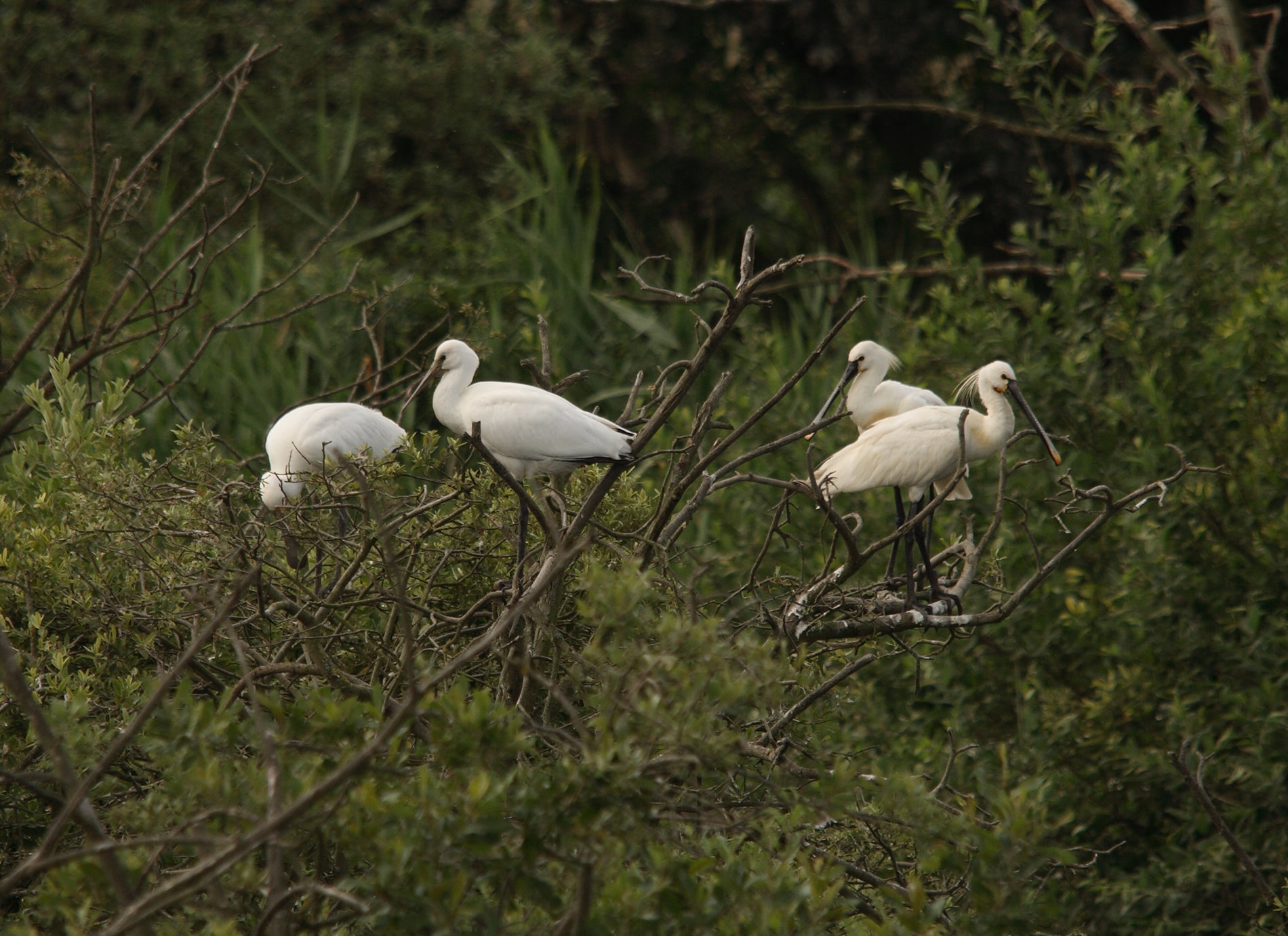
Spoonbills on the Holkham National Nature Reserve c. Andrew Bloomfield

Discover the secrets of Decoy Wood

May 20, 2026 | WONDER | 4 minute read

Andy Bloomfield, Holkham National Nature Reserve Senior Warden, explains how a new camera will capture rarely seen wildlife in action on the Holkham National Nature Reserve.

Life in the Holkham Heronry at Decoy Wood is never dull. During the breeding season, it is brimming with nesting Spoonbills, Cormorants, Grey Herons, Little and Cattle Egrets. A Holkham success story, it is one of the finest examples of a mixed breeding colony this side of the North Sea. This is largely due to its inaccessibility and position deep in the National Nature Reserve (NNR). As exciting as the colony is, it can be frustrating for visitors. The site resides in the depths of a willow woodland, where the thick cover is essential for nest sites. But it renders them invisible, even from the nearby hide.

Access is, quite rightly, prohibited, even to the wardens. It takes very little to make birds desert their nests, but what if they could be seen via a camera? This has been a long-held ambition of Lord Leicester’s, but the catalyst arose last year when a colony of Grey Herons nested at Ellesmere in Shropshire and gained nationwide exposure. Here, a network of cameras beamed live footage of the birds to a nearby café, instantly becoming a hit! Spurred on by the story, Holkham NNR staff visited the Leicestershire and Rutland Wildlife Trust’s Osprey Centre where Wildlife Windows had installed cameras.

These broadcast to the hides, visitor centre and a YouTube channel. We were impressed enough to progress a plan for Holkham’s Heronry. This would be unique as no British nesting Spoonbills or Cattle Egrets have ever been studied so closely. Following a visit by Jason Fathers of Wildlife Windows, a plan was formed. Visits to the wood by staff can only be made in Autumn and Winter, after the conclusion of the breeding season. We identified an area which is traditionally a favourable nesting area.

As the wood is a virtually impenetrable swamp, we made a short boat trip, hacking through age-old vegetation to a large oak tree where a camera with a zoom and wide-angle facility was mounted in a high branch. We now hope to monitor species’ interactions, predation events and biological behaviour, such as egg laying, hatching, chick feeding and, ultimately, fledging. In addition to a live broadcast at The Lookout, we hope to grow an online community of watchers who can contribute their own citizen science. Data will feed into the Eurasian Spoonbill International Expert Group, which studies and promotes worldwide conservation. This has the potential to be very exciting indeed!

Click here to see the camera’s live footage.

Back to Journal Back to Journal

Related journals