Well, I wasn’t expecting that! – The Hortus Gramineus Woburnensis.

August 28, 2026 | Treasure tales and archive snippets | 10 minute read

The library at Holkham incorporates a vast range of subjects, including some agricultural and horticultural gems. Having completed a wonderful week studying the development of Natural History books with the Institute of English Studies at the University of London last year, I was interested to explore those held by Holkham. During the course, I learnt that any book with Hortus in the title were likely to be fabulous, as these tended to contain detailed descriptions of plants and their environment, along with wonderful engravings (some coloured).

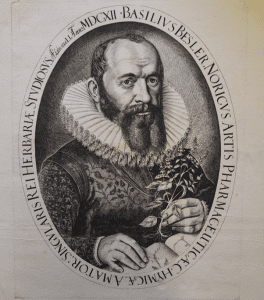
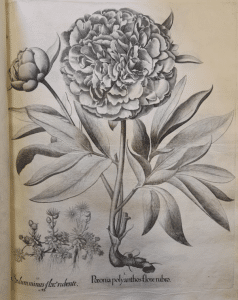
The Hortus Eystenensis by Basilius Besler, printed in 1613 and later purchased by Thomas Coke, 1st Earl of Leicester, definitely lived up to the expectation of beautiful engravings, but was lacking in descriptive text. Basilius Besler was an apothecary and botanist; he curated a botanic garden in Bavaria for Prince-bishop Johann Konrad von Gemmingen. The bishop commissioned Besler to create a book detailing every plant growing in the garden, a task which took him 16 years. This book is regarded as a ‘first of its kind’, both as a record of the plants from one collection and in its use of beautiful engravings, designed to be aesthetically pleasing and not solely scientific or informative. Holkham’s Hortus Eystenensis is a ‘white’ copy, meaning an uncoloured version, but is still amazing to view.

Portrait of Basilus Besler from the Hortus Eystenensis.


Engraving of a peony from the Hortus Eystenensis

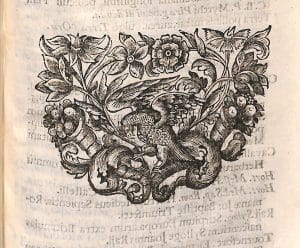
With the title Hortus Catholicus I was unsure whether the next volume I selected to investigate would fall into the horticultural or religious book category. Similarly to the Hortus Eystenensis, the Hortus Catholicus turned out to be a description of all the plants grown in one garden, this time owned by Francesco Cupani. Cupani was a Franciscan friar who had an interest in botany and developed this with a study of the plants and flowers of Sicily, where he lived and created his botanic garden. Published in 1696 the book is a printed list of all the plants found in Cupani’s garden with a short, written description of each, but no images. The only decorative element to the book is this woodcut of a bird within fruit and flowers found at the end of the text.

Woodcut from the end of the Hortus Catholicus

Having looked at two books, one of which was full of beautiful engravings but with no text, the other of which was full of text with no engravings, I then looked at a collection of of five books, all of which were written by or with the support of John Russell, 6th Duke of Bedford, and focused on his Woburn estate. Three of these had a title which included the term Hortus, two did not.
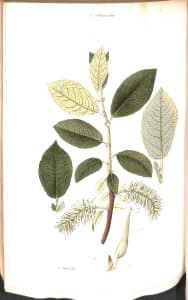
The Salictum Woburnensis: or, a catalogue of willows, indiginous and foreign at Woburn Abbey, was printed in 1824. The inscription inside the book shows that it was given to Thomas William Coke, 1st Earl of Leicester, as a gift directly from the Duke of Bedford; and that it was one of only 50 copies printed. In this book the reader found a full description of the plant, along with a beautiful illustration on the facing page.

Page from the Salictum Woburnensis

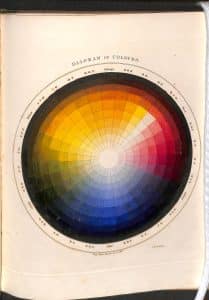
The publicaton of the willows of Woburn was followed a year later, in 1825, by Hortus ericaeus Woburnensis: or, a catalogue of heaths in the collection of the Duke of Bedford at Woburn Abbey. Inside is another signed inscription from the Duke of Bedford, this time to Lady Anne Coke, along with a letter suggesting the book ‘may perhaps afford you some ammusement’. This work does include a few coloured engravings of the heathers described, but what made it more interesting was an appendix at the back of the book. The Duke of Bedford had included a colour wheel, created by artist George Hayter, and the reason for this, he states, are the ‘mistakes and perplexities [which] arise with regard to the colours of plants, the same plant being frequently described under different denominations of colours by different nursery gardeners of draughtsmen’. The Duke of Bedford hoped that the colour wheel ‘will not only point out, with accuracy and precision, the exact colour of each plant in the Catalogue, but may, I trust, become of general utility to Botanists and Florists, if adopted as an universal standard.’

George Hayter’s Colour Wheel

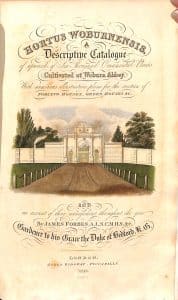
Continuing the Woburn series is Hortus Woburnensis, a descriptive catalogue of upward of six thousand ornamental plants cultivated at Woburn Abbey and an account of their management throughout the year. Printed in 1833 this work is a huge list of all the ornamental plants at Woburn. Each plant is given one line, which includes information about name, leaf type, time of flowering, country of origin, and date first planted at Woburn. However, again, there are no nice illustrations to view. Thomas William Coke is listed amongst the subscribers to this work [people who pay something towards the final book before it’s printed, offsetting some of the risk for the publisher – almost like crowdfunding], but the condition of the book perhaps suggests that he was starting to tire of the Duke’s botanical works. The pages in the book are uncut, meaning that whilst you can see both sides of some, others are still attached at the top and clearly the book has never been read.

Title page from the Hortus Woburnensis

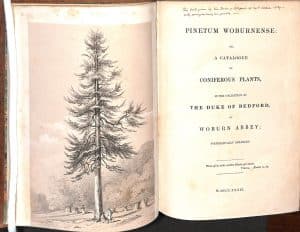
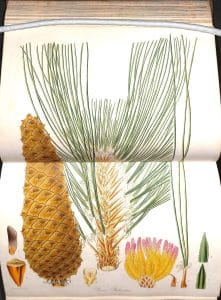
With the Pinetum Woburnense: or, a catalogue of coniferous plants in the collection of the Duke of Bedford at Woburn Abbey; systematically arranged. we return to books with wonderful botanical illustrations. Each pine specimen is given a double page engraving, which has been coloured, and a page of written description. Within the introduction to the work the Duke of Bedford also describes how the engraving used for the frontispiece was taken from a drawing by his own daughter-in-law, Lady Charles Russell. This book found its way to the Holkham collection not by a gift from the Duke of Bedford to Thomas William Coke, or to Anne, but via a gentleman called Edward Ellice. The inscriptions within the Pinetum Woburnense show it was gifted to Ellice by the Duke of Bedford, and was one of only 100 copies printed. Ellice, like Thomas William Coke, was a politician and strong supporter of the Reform Act, and can be seen standing alongside others in the plaque celebrating the passing of this Act in 1832, displayed in the Marble Hall. A year after Thomas William Coke’s death in 1842 Ellice married Lady Anne Coke, and then gifted this book to his now step-son, Thomas William Coke, 2nd Earl, in 1844.

Frontispiece for the Pinetum Woburnense, drawn by Lady Charles Russell


Engraving page from the Pinetum Woburnense

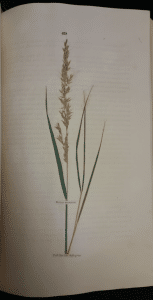
This brings us round to the first of the Duke of Bedford’s studies, the Hortus Gramineus Woburnensis: or, an account of the results of experiments on the produce and nutritive qualities of different grasses and other plants, used as the food of the more valuable domestic animals. This is the book that made me exclaim, ‘well, I wasn’t expecting that!’. Printed in 1816, the Hortus Gramineus Woburnensis is a large, heavy book contained within a wooden book box. The focus of this work was to describe in detail the grasses and other plants used to feed cattle and sheep, and compare their nutritional benefit and growing conditions to optimise production. As before, each species of grass is described in detail with a full page of text; but instead of an engraving each description is accompanied by a real piece of grass with seeds and roots. The grass specimens have been pressed, dried and then painted, before being attached to the page with small paper tabs. If this book had been created by an individual, for their own entertainment, I perhaps would not be as surprised; but to find this as an integral part of a printed book, with other copies created, felt unusual. It appears that the Duke of Bedford reverted to the more usual engravings for the second edition!

Page from the Hortus Gramineus Woburnensis

The Hortus Gramineus Woburnensis just goes to show that you definitely should not judge a book by its cover, and that you never know what wonders are next to be discovered in Holkham’s library.

Written by Jo Bannister

Back to Journal Back to Journal

Related journals