Lady Margaret Tufton’s Lasting Legacy at Holkham
December 12, 2025 | Treasure tales and archive snippets | 10 minute read
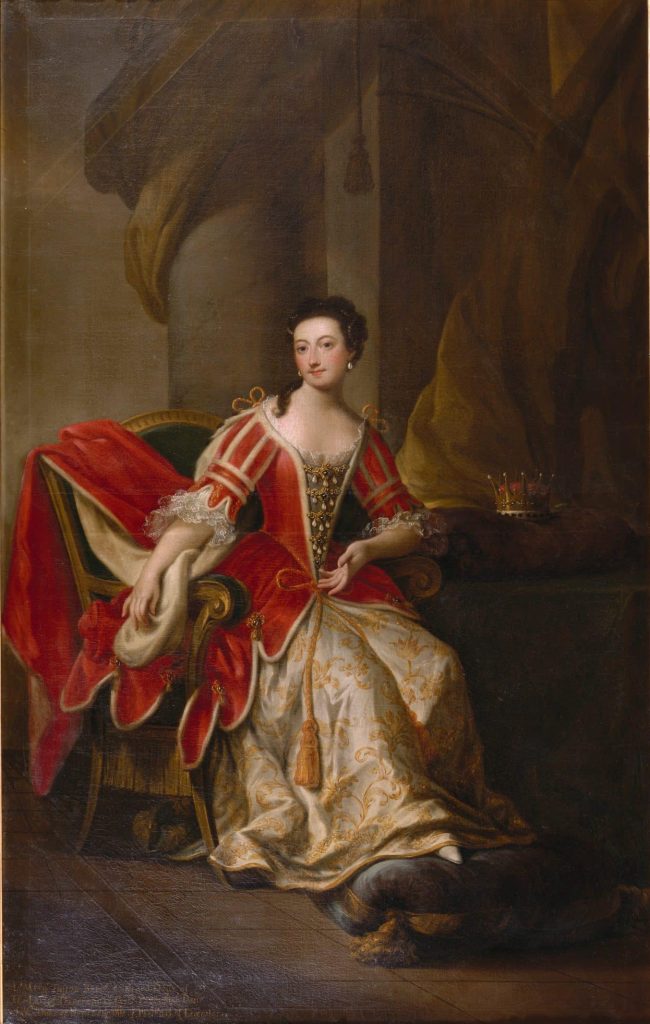
Continuing to celebrate the 250th anniversary of the death of the truly magnificent Lady Margaret Turfton let’s turn to look at her legacy outside the Hall.
Visitors approaching from the coast road to the north will be aware of The Victoria, the model village and the steady rise to the gates flanked by possibly Lady Margaret’s biggest contribution, the Almshouses. Forming the east and west sides of a square with an adjoining wall, construction started in 1756 where they were at a slight adjunct to the village below; it was only in the nineteenth century when the 2nd Earl rerouted the entrance to the park that the Almshouses took a more prominent role in the landscape of Holkham.
An Almshouse is defined as a unit of residential accommodation that belongs to a charity, with which there are generally strict conditions governing occupancy. The aims of the charity are to provide hospitality to those in need. The oldest almshouse in the country, the Hospital of St Oswald in Worcester, can trace its roots back over a millennium. In more recent times, establishing charitable endowments such as almshouses, schools, hospitals and reading rooms were often established by the wives and daughters of the landowners as a way of looking after the families that lived on their estates. This is the case at Holkham too.
In 1753, Edward, Viscount Coke died leaving Holkham and the peerage heirless. Throughout his short life he had wanted for nothing but his dissolute life and disastrous marriage must have been a great worry and ultimate disappointment to his parents. After his death his parents threw themselves into their passions at Holkham, for Thomas it was in the Hall both in its execution and expanding his remarkable collections. But Lady Margaret looked outside. Her commitment to the people of Holkham and surrounding villages was long-established: since 1722 she had kept an account of the flour and bread, and clothes she distributed to the poor of the parish. It was still in use half a century later. She now drew up plans to create the almshouses which would be her lasting legacy that could provide for the elderly at Holkham.

A page listing recipients of beef and flour, Christmas 1752 in Lady Margaret’s papers.
Within a title deed held in the archives, dated 5 April 1756, Lady Margaret sets out how the charity would operate and its purpose. From her own money she gave Lord Leicester £1250 for the parcel of land to erect the almshouses, as well as the promise to a yearly grant of £50 from land at Holkham Staithe. She also put in £800 which had been bequeathed to her from her father intended for charitable purposes to cover the design and construction costs. In addition, she bought farmland at Weasenham St Peter and Weasenham All Saints whose profits would fund the longevity of the charity.
-

- Settlement deed for the establishment of the Almshouses, it was signed and sealed by Thomas (Leicester) and Margaret.


The design chosen for the Almshouses was very different to the Palladian style of the hall. Built using Holkham bricks. it was more in keeping with the local vernacular style but included distinctive crow-stepped gables. Each row had three houses, comprising a living room with hearth, closet and larder. Residents would have used the bakehouse in the village for baking bread. They were tweaked with the arrival of the new gothic entrance way designed by S.S. Teulon in the 1840s when the road was rerouted. At a later date a rear toilet block was added.
The plaque on the end of the Almshouses states ‘Endowed by her for the Benefit of Three Poor Men and Three Poor Women THOMAS Earl of THANET Her Father was a Benefactor By a Legacy he left her of Eight Hundred Pounds for Charitable Uses’ It can be found on the south end of the eastern block, just visible to walkers in the park.
-

- The Almshouses today, the western block (l) the eastern block (r)


To be eligible for admittance into the almshouses, Lady Margaret set out the stipulations that needed to be met:
- No man or woman to be put in that have not a settlement in the some of the parishes where the Earl of Leicester’s Estates now lye in the County of Norfolk
- No man to be received under the age of 60 years
- No woman under the age of 50 years – except they are by accident or disease, lame or blind. A discretionary person is allowed to admit under that age provided the misfortune foes not proceed from debauchery
- No women of a loose character to be admitted.
- If any of the inhabitants of this almshouse are guilty of theft, drunkenness, receiver of stolen goods, harbouring of false persons, abusive, malicious or troublesome to their neighbours to be turned out immediately never again be admitted
On a successful application, each resident would receive a weekly allowance of 2s 6d and be given a chaldron of coals twice yearly on 1 November and 1 March. Additionally, every two years the charity would provide each man with a great coat costing 25s or less and each woman a gown of 20s or less, which were to be a blue colour. Clothes were passed down successive residents.
Within a decade, the Dowager Countess of Leicester wanted to make some changes. She felt that the allowance was too frugal and each person had an extra shilling each week, taking their allowance to 3s 6d.
Records for the earliest beneficiaries of this charity have not survived, but a later account book shows in 1775 three men: Robert Franklin, James England, and James Bird; and three women Mary Madder, Ann Allen and Widow Rutley all receiving 4s per week. Using parish records, Widow Rutley was called Elizabeth and her husband had been Francis who died in 1774. Elizabeth was buried at St Withburga’s in January 1780 aged 73. There is no record of any Rutley’s working for the estate in the eighteenth century, instead Elizabeth must have been a needy parishioner.
After the death of her husband, Thomas in 1759, Lady Margaret’s became a more solitary figure, choosing to spend the majority of her time at Holkham and entertained quietly. She still visited families on the estate and one account written in 1766 describes her actions: ‘she does great good, keeps many families, but is only beloved by the poor… she is for ever sending us good things, yesterday a monster pike and nine pairs of large soles, she loads us with sweatmeats for the child, and is always saying or doing something obliging to us;
Once the hall was completed in 1764, Lady Margaret then turned her attention to St Withburga’s, the parish church which was then outside the park, but its elevated location had always made it a prominent vista. The church has its origins in the mists of time, but the tower dates from the thirteenth century with later works from the fourteenth century. In total, Lady Margaret spent £1000 (approximately £90,000 today) to repair the church and in a letter held elsewhere, her friend Mrs Delany wrote after visiting Holkham to a mutual friend on the restoration ‘the inside is striking, all new work of Lady Leicester’s’. A further description of the work undertaken can be found in Francis Blomefeld’s History of Norfolk:
‘In the spring of 1767 her ladyship began to repair Holkham church. All the outside walls and stone window frames were repaired throughout; the roof made strong and part of it new leaded: the inside of the whole stuccoed and new ceiled; the floors entirely new paved; the pews and seats all new an erected in regular form. The pulpit, desks, communion table and rails thereto all mahogany a marble font, plate for the communion, linen and books for the services, the old monuments restored, the vestry room fitted up, and all the windows new glazed. The whole was finished at Easter 1768’.
The work was carried out by a Joseph Rose, and research suggests that he may possibly have been part of the Joseph Rose & Co family firm of plasterers based in London. This firm knew Gavin Hamiliton and Joseph Nollekens, artists who were personally known to Thomas Coke and Lady Margaret. Additionally, Joseph Rose had undertaken work at Felbrigg Hall in the 1750s so perhaps was already familiar with the Holkham estate.
Unfortunately, the repairs were not to be long-lasting, just over a century later, extensive repairs were undertaken by Lady Juliana and much of Lady Margaret’s work was removed. A lithograph drawn in the 1820s by Robert Ladbrooke depicts St Withburga’s as Lady Margaret would have seen it. Interesting to note is the crenelations or battlements on the to the roof as well as the tower which were removed in the later repairs. A design feature of the Almshouses is the gables, could Lady Margaret have been referencing the church roofs in the designs for her contribution to the estate?

Etching of St Withburga’s, Robert Ladbrooke. Image courtesy of Norfolk County Council at www.picture.norfolk.gov.uk
Written by Lucy Purvis, Archivist
Back to Journal Back to Journal