A history of The Victoria and Ancient House in Holkham Village
January 21, 2026 | Treasure tales and archive snippets | 7 minute read
We are often asked by guests who stay with us about the history of these two very varied but fascinating buildings. The Victoria’s receptionist Immy has been researching and collating information and is delighted to share her research with you.
The Victoria
The Victoria was originally an inn known as the Albemarle Arms and stood in roughly the same position as the current building. In 1837, Thomas William Coke bought the site and agreed to construct a new public house. It was in this same year that the young Queen Victoria elevated him to the peerage, hence why he named the new inn ‘The Victoria’.
Thomas had bought the land and the inn from a carpenter called John Lack whose family had owned the land for nearly 100 years. Lack sold the site for £600 but held the lease for another 21 years. When he died in 1846, his widow, Hannah, continued as the landlady. The only additional staff at this time was a barmaid, a housemaid, a cook and an ostler (a man employed to look after the horses of people staying at the inn). The Lack family left in 1883, handing over tenancy to George Young Smith, who made many much needed alterations to the building.

staff c.1940 at The Victoria
Originally, the urinals were located under the best bedroom window – surprisingly, this was not too popular – and in the 1930s the tenants stated that ‘the accommodation is so limited that it is difficult to provide adequately for resident guests and those calling for meals’. They even looked to transfer the licence to Ancient House (more on that building later). An extension was granted in 1935, as was the installation of electric lighting. The extension provided a larger coffee room and lounge, the conversion of the public bar into a saloon bar, and a new public bar which was built out into the yard immediately adjacent to the old bar. The inn had no mains water until 1965 so the 1960s brought a modernization programme to provide bathrooms and inside toilets.

The Victoria c. 1965
In the more recent years, The Victoria went under Adnams management with a colonial style theme before coming under the management of the Coke family once more in 2013. It was at this stage that the current Managing Director was put into post and he, along with several other members of the staff, have been with us ever since.
And the staff aren’t the only thing to have survived all this time! One custom that has been part of The Victoria’s offering since its establishment nearly 200 years ago is that guests were given passes for the use of Lady Anne’s Drive without having to pay the normal toll. This practice still continues today, changing from tokens to allow access on foot, to car parking permits for guests’ vehicles.
The Victoria’s Room Names
Each of the rooms at The Victoria are named after an aspect of one of the five shooting beats on the Holkham Estate: The Park, Wells, Waterden, Wighton and Overy. The game department is made up of a Head Keeper and four beat keepers who manage the five different beats.
The clumps and belts of woodland which were planted in Thomas William Coke’s time (1754-1842) afforded ideal woodland-edge habitat for pheasants and contributed greatly to the pre-eminence of the Holkham shoot and in particular, the driven (or covert) shooting that was brought to perfection by his son, the 2nd Earl of Leicester (1822-1909).
The room names are: Hare Clump, Tutsia Clump, Honk’s Pit, Crabbe Castle Pit, Scarborough, Water Mire, Mouse Hill, Blunt’s Corner, Hanging Fallow, Joe’s Stop, Bush Close, Waterden, Cow Planting, Wilbrahams, Dale Hole, Lime Kiln, Fushia, Pistol Club, Emmerdale and Bone’s Belt.
The Ancient House
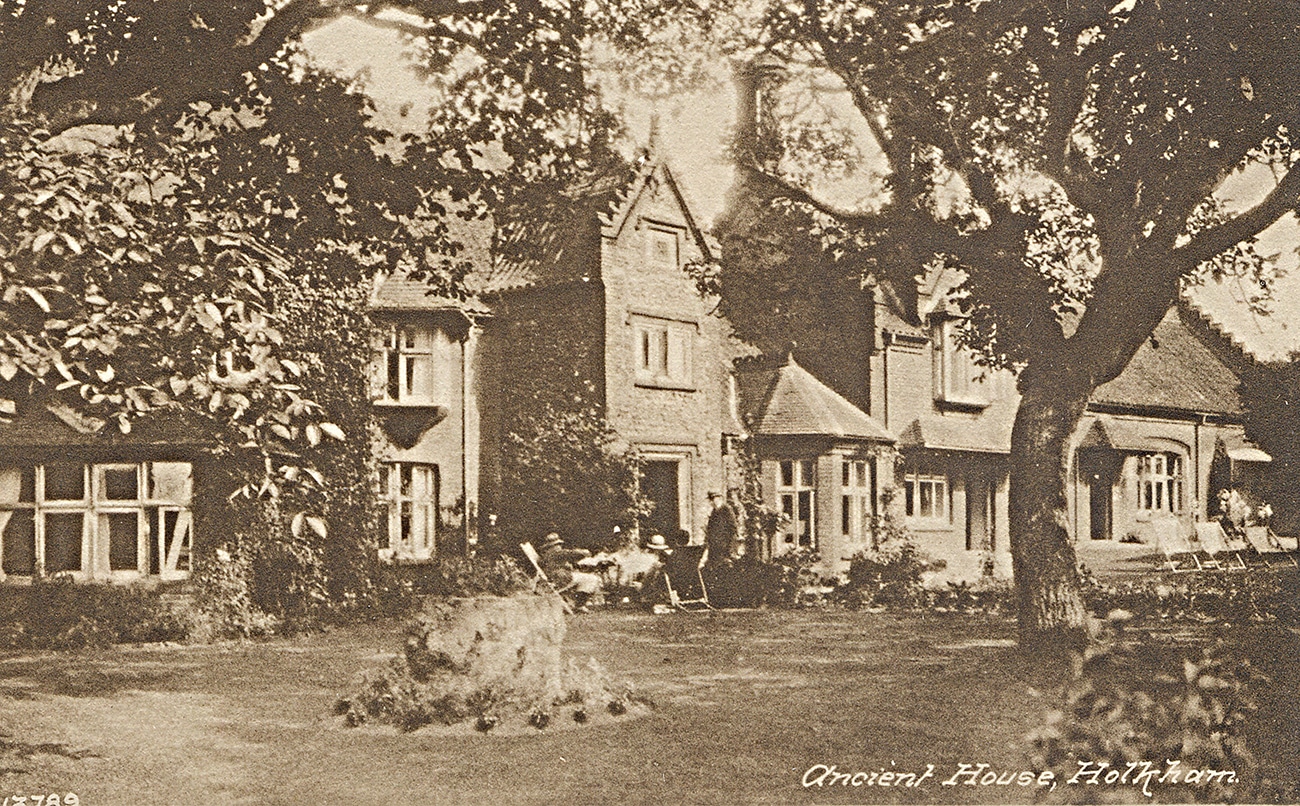
The Ancient House is possibly the oldest building in Holkham village, rivalled by only St Withburga’s church and possibly the ice-house near the Hall. Parts of the building that stand today have survived every stage of its history, from the Middle Ages to a 20th century tourist destination. The medieval high street still survives as a track at the back of the house – in part at least.
From the 13th to 15th century, Ancient House was called “the house by the shore” (when the sea was a lot closer) and was the property of the Northerne family who also held the land at Holkham. Their property was then inherited by the Newgate family and in 1659, John Coke bought Ancient House from Edmund Newgate.
Several tenants used the land for farming but in 1810 when the final tenant’s wife died, the house itself was divided into two as it was no longer required as a farmhouse and had lost its yard and premises. Nevertheless, part of the building took on a new role as a bakery which was to last over one hundred years in the hands of only three men – John Copping, Russell Emerson and Isaac Julings. The original bread oven can still be seen in Fushia, room 17.

Julings family outside Ancient House
Architect Zephaniah King was commissioned for the redesign in 1885. The Ancient House was to be preserved, but it was extensively altered and extended at a cost of £827 – more than a pair of new cottages. This included the bay windows and the Tudor style chimneys. Few details survive about the alterations, but it is clear that the bricks were provided by the Holkham brickworks at Peterstone. King also designed other buildings in the immediate vicinity. The Julings family, tenants since 1869, enjoyed the results of the renovation until 1914 when it became a lodging house.
Paradoxically, it seems to be after these extensive additions and alterations of the 1880s that the house was for the first time called “the Ancient House”.

Plan of alterations to Ancient House in 1885
During and after the First World War, it was used as a boarding house, let for £30 per annum, and by 1935, the house was used as an annexe of the Victoria Hotel and remained so until 1971.
Between 1940 and 1945, the Ancient House was again requisitioned for army use as were most of the Victoria hotel and parts of the Hall.
In 1971, the Ancient House became a showroom and shop for the Holkham Pottery which had been established in the 1950s by the then Countess of Leicester and after short-lived attempts by tenants to establish a restaurant in the southern part of the building, the tea rooms opened under estate management. In 1978, the village Post Office was installed at the back of the house.
In 2014, the Holkham Estate embarked on the first major development of the Ancient House building in over 100 years. On 1st May 2015, it reopened and now provides 10 non-dog friendly rooms as an addition to the 10 dog-friendly rooms in the Victoria Hotel.
All information was gathered by the Holkham Archive team and from ‘Holkham’ by Christine Hiskey.
Back to Journal Back to Journal